
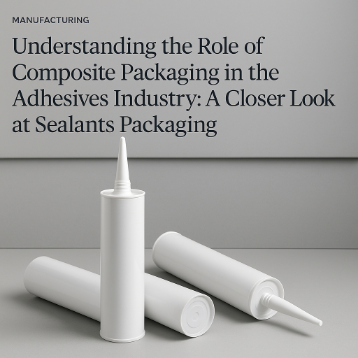
In the adhesives industry, packaging is not a secondary decision made after formulation is complete; it is part of the product itself. Adhesives and sealants are highly sensitive to air exposure, moisture, contamination, and poor dispensing conditions, which means the package has a direct influence on shelf life, application quality, and user confidence. That is why sealants packaging deserves closer attention, especially as manufacturers balance performance, convenience, material compatibility, and cost in increasingly demanding markets.
Why packaging matters in the adhesives industry
Adhesives and sealants operate under strict performance expectations. They must remain stable in storage, dispense smoothly at the point of use, and cure as intended once applied. If the package fails to protect the formulation, the product may thicken, separate, skin over, or react too early. In practical terms, that can lead to wasted material, inconsistent bond strength, messy application, and avoidable complaints across industrial, construction, automotive, and maintenance settings.
This is where composite packaging plays a meaningful role. Unlike single-material formats, composite structures combine layers or materials to achieve a more tailored balance of strength, barrier protection, weight, and usability. In the context of the adhesives industry, that often means better resistance to moisture ingress, improved dimensional stability, and packaging that supports efficient dispensing without compromising the contents.
For buyers and production teams, the right packaging choice can also affect:
- Product integrity during storage and transport
- Dispensing accuracy in manual or automated application
- Worksite cleanliness and ease of handling
- Inventory efficiency through appropriate pack size and format
- Brand perception through reliability and consistency
When evaluating sealants packaging, the discussion should therefore go beyond appearance or unit cost. The more important question is how well the packaging protects the chemistry and supports real-world use.
What composite packaging actually does
Composite packaging refers to packaging built from more than one material or layer so that each element contributes a specific function. In adhesive and sealant applications, those functions typically include structural support, barrier performance, puncture resistance, dimensional stability, and controlled dispensing. The aim is not complexity for its own sake, but a more precise response to the demands of the product inside.
A sealant cartridge, for example, must do several things at once. It needs to hold viscous material securely, resist deformation during transport, fit dispensing tools consistently, and maintain a dependable interface between the package and the nozzle or closure system. In some applications, it must also help limit interaction between the product and the external environment over time.
Composite formats are often valued because they can offer:
- Layered protection against moisture, oxygen, or light where relevant
- Better structural performance without excessive weight
- Greater design flexibility for specific dispensing systems
- Balanced cost control compared with heavier all-metal alternatives
- Improved handling for users who need clean, predictable application
In the adhesives sector, packaging has to work with the product rather than simply contain it. Composite constructions can be especially useful where a single material alone would struggle to deliver the right mix of barrier function, compressive strength, and user practicality.
Core performance requirements for sealants packaging
Not every adhesive or sealant has the same packaging demands. A moisture-curing sealant, for instance, may require more careful protection than a less reactive material. Even so, several performance requirements are broadly relevant across the category, and they help explain why composite packaging remains important.
Material compatibility
The packaging material must not negatively interact with the formulation. If there is migration, absorption, or chemical incompatibility, product stability can suffer. Compatibility testing is therefore essential, particularly for aggressive or specialty chemistries.
Barrier protection
Many adhesive products are vulnerable to air and moisture. Effective barrier performance helps preserve intended viscosity, prevents premature curing, and extends usable shelf life under proper storage conditions.
Mechanical strength
Packaging needs to withstand filling lines, stacking, transport stress, and end-user dispensing pressure. Weakness in the body, seams, closures, or nozzle area can create leakage, deformation, or application problems.
Dispensing reliability
The best packaging supports controlled flow and a clean finish. In professional environments, reliable extrusion matters because uneven output can slow work, increase waste, and compromise results.
Storage and transport resilience
Temperature shifts, vibration, compression, and long distribution cycles all place demands on packaging. Composite formats are often selected because they can better manage this combination of practical stresses.
| Packaging consideration | Why it matters | What to assess |
|---|---|---|
| Barrier performance | Protects product from moisture and air exposure | Layer structure, closure seal, storage conditions |
| Structural integrity | Prevents collapse, leaks, and handling damage | Body strength, seam quality, fit with dispensing tools |
| Compatibility | Preserves formulation stability | Interaction with resin system, additives, and cure mechanism |
| Usability | Improves application consistency and reduces waste | Nozzle design, extrusion behavior, pack ergonomics |
| Operational fit | Supports manufacturing and logistics efficiency | Filling line suitability, storage footprint, transport durability |
How to choose the right composite packaging format
Selecting packaging for adhesives is rarely a one-variable decision. The most effective choice usually comes from weighing product chemistry, filling method, end-use environment, and customer expectations together. A package that performs well in one category may be a poor fit for another.
A disciplined selection process often includes the following steps:
- Define the formulation profile. Understand sensitivity to moisture, oxygen, temperature, and package-material interaction.
- Map the use case. Determine whether the product is intended for precision application, heavy-duty field use, consumer retail, or industrial production lines.
- Review dispensing requirements. Consider viscosity, flow behavior, and the tools or systems used to apply the product.
- Test transport and storage performance. Simulate realistic conditions rather than relying on assumptions.
- Evaluate total operational impact. Include filling efficiency, reject rates, damage risk, storage, and user satisfaction.
For many manufacturers, this is where composite packaging becomes particularly attractive. It offers room to fine-tune performance without defaulting to the heaviest or simplest option available. That flexibility can be valuable when product lines include different sealant types, varied pack sizes, or multiple distribution channels.
At the same time, overengineering is not always the answer. The right package is the one that meets technical requirements consistently and economically. A premium adhesive does not automatically require the most complex format, but it does require a packaging solution matched to its actual exposure risks and application demands.
Sustainability, waste reduction, and the future of packaging decisions
Sustainability has added a new dimension to packaging selection in the adhesives industry. Buyers increasingly want packaging that protects the product effectively while also supporting better material efficiency, lower transport burden, and more responsible disposal pathways. Composite packaging can contribute to these goals when it reduces product waste, maintains shelf life, and avoids failures that lead to discarded material.
That said, sustainability should be evaluated carefully and honestly. A package that uses fewer resources but causes spoilage or leakage is not truly efficient. In adhesive and sealant categories, preserving the usable product is a major part of responsible packaging design.
Useful questions for manufacturers and procurement teams include:
- Does the packaging help reduce product waste during storage and application?
- Can the format improve transport efficiency through lower weight or smarter geometry?
- Is the pack durable enough to avoid damage-related losses?
- Can material choices be optimized without sacrificing compatibility and barrier performance?
- Does the design support cleaner, more complete dispensing?
The future of sealants packaging will likely be shaped by the same core principle that has always mattered most: performance first, but not performance in isolation. The strongest packaging decisions are those that connect product protection, user experience, operational efficiency, and environmental responsibility in a realistic way.
Composite packaging has earned its place in the adhesives industry because it solves practical problems that directly affect product quality and usability. From protecting sensitive formulations to improving dispensing consistency and transport resilience, it supports the full life cycle of adhesive and sealant products. For manufacturers, distributors, and professional users alike, better sealants packaging is not just about containment. It is about preserving performance from factory to final application, and that makes packaging a strategic part of the product itself.
